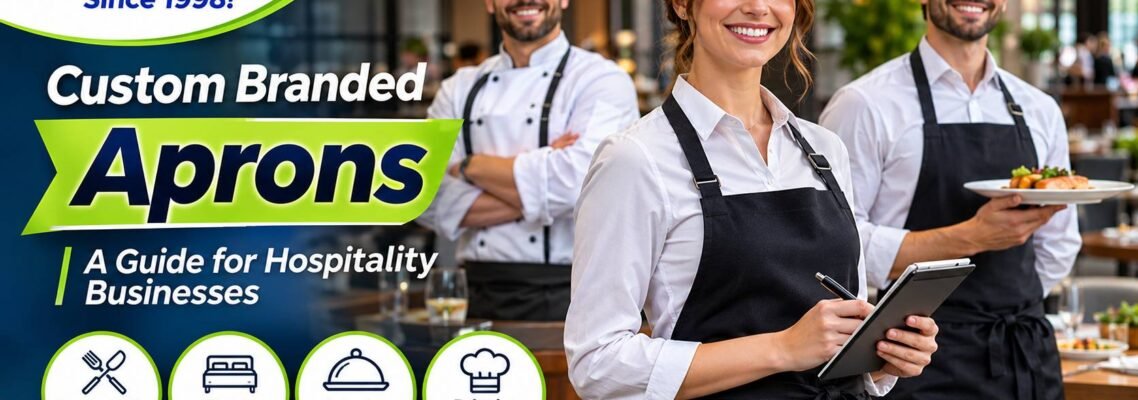
Custom Branded Aprons: A Guide for Hospitality Businesses
Professional uniforms play an important role in how customers perceive hospitality businesses. From hotel restaurants and cafés to catering companies and commercial kitchens, custom branded aprons help businesses maintain a consistent appearance while providing employees with practical workwear.
Selecting the right apron involves more than choosing a color and adding a company logo. Fabric durability, employee comfort, decoration methods, functionality, laundering requirements, and replacement costs all influence the long-term value of a branded apron program.
Digitized Logos provides branded apparel and promotional product solutions to help businesses develop merchandise and uniform programs that reflect their brand identity and operational requirements.
What Are Custom Branded Aprons?
Custom branded aprons are functional workwear garments personalized with a company’s logo, colors, business name, or other brand elements. They are commonly used by restaurants, hotels, cafés, bakeries, catering companies, breweries, and food service organizations.
Unlike standard aprons, branded aprons combine workplace functionality with visual brand identification. They can help establish a coordinated employee appearance while protecting clothing from everyday spills, stains, and general workplace mess.
Quick Answer: What Type of Branded Apron Is Best for Hospitality Businesses?
The most suitable branded apron depends on employee responsibilities, working conditions, laundering frequency, and brand presentation requirements. Bib aprons generally provide greater clothing coverage, waist aprons offer convenient storage and mobility for servers, and cross-back aprons can improve comfort by distributing weight across the shoulders.
Businesses should evaluate fabric performance, fit, pocket placement, logo decoration, and replacement requirements before placing a bulk order.
Why Custom Branded Aprons Matter for Hospitality Businesses
Hospitality employees frequently interact with customers, making their appearance part of the overall guest experience. A coordinated apron program can support brand recognition while maintaining a professional and organized workplace.
- Consistent brand identity: Coordinated aprons help establish a recognizable appearance across departments and locations.
- Professional presentation: Employees wearing matching workwear can contribute to a more cohesive customer-facing environment.
- Practical functionality: Suitable apron designs provide clothing coverage and storage for everyday work essentials.
- Employee identification: Different colors or styles can distinguish departments and employee responsibilities.
- Operational consistency: Standardized apron specifications can simplify purchasing, onboarding, and replacement orders.
- Brand visibility: Company logos remain visible during customer interactions, catering activities, and hospitality events.
Types of Custom Aprons for Hospitality Businesses
1. Bib Aprons
Bib aprons extend from the chest toward the legs, providing broader clothing coverage than waist aprons. They are commonly used by chefs, baristas, kitchen staff, bakers, and food preparation employees.
The upper chest area typically provides a suitable location for an embroidered or printed company logo. Adjustable neck straps and functional pockets may improve usability, depending on the selected design.
2. Waist Aprons
Waist aprons cover the lower portion of the body and are frequently used by restaurant servers, bartenders, and hospitality attendants. Their compact design allows employees to move comfortably while carrying order pads, pens, and other small work essentials.
Businesses should consider pocket dimensions and accessibility before selecting waist aprons for customer-facing teams.
3. Bistro Aprons
Bistro aprons are typically longer waist aprons associated with restaurants, upscale dining establishments, and hotel food service operations. Their extended coverage and streamlined appearance make them suitable for environments where presentation is a priority.
Subtle logo decoration and coordinated uniform colors can complement a refined hospitality brand identity.
4. Cross-Back Aprons
Cross-back aprons use straps that extend across the shoulders and back rather than concentrating support around the neck. Depending on their construction and fit, these aprons can reduce pressure on the neck during extended periods of wear.
They are often considered for coffee shops, artisan bakeries, commercial kitchens, and employees who wear aprons throughout longer shifts.
5. Full-Color Printed Aprons
Full-color printed aprons allow businesses to incorporate detailed artwork, patterns, brand colors, and promotional graphics. They can be particularly useful for culinary events, seasonal campaigns, product demonstrations, and hospitality concepts with distinctive visual identities.
The suitability of full-color printing depends on the apron material, construction, and selected decoration process.
Choosing the Right Apron Material
Apron material directly influences comfort, appearance, maintenance, and durability. Hospitality buyers should evaluate how the fabric performs under actual working conditions rather than selecting products based solely on appearance.
Cotton
Cotton aprons offer a natural feel and generally provide good breathability. They can be suitable for cafés, bakeries, restaurants, and customer-facing hospitality environments.
Depending on fabric construction and care practices, cotton may wrinkle, shrink, or retain moisture more readily than certain synthetic alternatives.
Polyester
Polyester aprons generally offer good dimensional stability and wrinkle resistance. Suitable polyester fabrics also support dye sublimation printing, allowing businesses to incorporate detailed, full-color designs.
Fabric weight, weave, and finishing treatments should be evaluated when assessing comfort and durability.
Polyester-Cotton Blends
Polyester-cotton blends combine characteristics of synthetic and natural fibers. They are frequently considered for hospitality workwear because they can provide a practical balance of comfort, appearance retention, and maintenance requirements.
Actual performance varies according to fiber composition, fabric construction, and laundering conditions.
Canvas and Denim
Canvas and denim aprons can create a distinctive, premium appearance for specialty cafés, bakeries, breweries, and artisan food businesses. Their heavier construction may provide additional durability but can also increase garment weight and warmth.
These materials should be evaluated against employee comfort requirements and the physical demands of each role.
Best Customization Methods for Branded Aprons
The appropriate decoration method depends on the fabric, logo complexity, intended appearance, laundering requirements, and order quantity. Buyers should evaluate decoration durability alongside initial production costs.
Embroidery
Embroidery uses stitched thread to reproduce a logo or design directly on the apron. It provides a textured, professional appearance that can complement hotel uniforms, restaurant workwear, and premium hospitality apparel.
Embroidery is generally suitable for simpler logos and text-based designs. Very small lettering, intricate gradients, and highly detailed artwork may require adjustments before production.
Screen Printing
Screen printing applies ink to the fabric through prepared screens. It can be an effective option for bold logos, solid-color artwork, and larger quantities of coordinated aprons.
Production costs and suitability depend on the number of colors, artwork complexity, fabric, and order quantity.
Heat Transfer Printing
Heat transfer printing applies a prepared design to the fabric using heat and pressure. Depending on the transfer technology and material compatibility, it can reproduce detailed artwork and multicolor logos.
Businesses should confirm laundering instructions and decoration durability before selecting heat transfer printing for frequently washed uniforms.
Dye Sublimation
Dye sublimation uses heat to transfer dye into compatible polyester-based materials. Unlike surface-applied decoration methods, sublimation integrates color into the receptive material rather than creating a separate printed layer on top of the fabric.
Digitized Logos’ InfiColor dye sublimation approach can be considered for suitable apparel projects requiring detailed artwork, coordinated brand colors, patterns, and full-color graphics. Product compatibility should be confirmed before production.
Personalized Aprons for Hospitality Businesses
Businesses purchasing personalized aprons for hospitality businesses can develop uniform designs that reflect departmental responsibilities, employee identities, and customer-facing brand standards.
Personalization can extend beyond a company logo to include employee names, job titles, department identifiers, and location-specific branding.
- Restaurant aprons with company logos and employee names.
- Hotel kitchen aprons with departmental branding.
- Barista aprons featuring café logos and signature colors.
- Catering aprons with coordinated event branding.
- Bakery aprons with distinctive patterns and business names.
- Promotional aprons for culinary demonstrations and food festivals.
- Hospitality uniforms with different apron colors for individual departments.
Businesses should balance personalization with inventory flexibility. Individually named aprons cannot always be reassigned to other employees, which may increase replacement requirements when staffing changes.
How to Order Custom Branded Aprons for Your Business
A structured purchasing process can help hospitality businesses reduce artwork errors, unsuitable product selections, and unnecessary replacement expenses.
- Identify employee requirements. Determine which departments need aprons and evaluate their daily responsibilities, mobility requirements, and exposure to spills.
- Select appropriate apron styles. Choose bib, waist, bistro, or cross-back designs according to employee roles and working conditions.
- Evaluate fabric specifications. Consider material composition, fabric weight, care requirements, and decoration compatibility.
- Prepare company artwork. Supply high-quality logo files, preferably in a suitable vector format, together with brand color references.
- Choose a decoration method. Evaluate embroidery, printing, heat transfer, or dye sublimation according to the selected apron and artwork.
- Review the artwork proof. Confirm logo placement, dimensions, spelling, color references, and overall appearance before approving production.
- Confirm purchasing details. Review quantities, minimum order requirements, production schedules, shipping arrangements, and applicable charges.
- Establish a reorder process. Retain approved artwork, product specifications, and decoration details for future purchases.
Behind the Scenes: How Artwork Affects Apron Production
Logo preparation is one of the most important stages of customized apron production. Artwork that looks clear on a computer screen may not reproduce effectively when embroidered or printed at a smaller physical size.
For embroidery, artwork generally requires digitization into a stitch-compatible format. Fine lines, small text, and complex details may need modification to achieve a readable result.
For printed decoration, image resolution, color references, fabric color, and print dimensions influence the finished appearance. Dye sublimation also requires compatible material and appropriate artwork preparation.
Logo positioning should account for pockets, seams, adjustable straps, and how the apron sits when worn. A design placed too close to a pocket opening or seam may create production difficulties or reduce visibility.
Maintaining an approved physical sample, when practical, alongside digital artwork specifications can help businesses evaluate consistency during future reorders.
How Much Do Custom Branded Aprons Cost?
The cost of branded aprons varies according to the garment style, fabric, decoration method, artwork complexity, quantity, personalization requirements, and shipping arrangements. There is no universal price that applies to every customized apron order.
When comparing quotations, hospitality buyers should consider the complete purchasing cost rather than the advertised garment price alone.
- Base apron cost and material quality.
- Logo decoration charges.
- Artwork preparation or embroidery digitization fees, where applicable.
- Individual name or department personalization.
- Minimum order requirements.
- Sample and proof-related charges, where applicable.
- Packaging and shipping expenses.
- Future replacement and reorder costs.
A lower initial price may not represent better long-term value if the apron requires frequent replacement, loses its professional appearance, or does not meet employee requirements.
Minimum Order Quantities and Production Turnaround
Minimum order quantities and production turnaround times depend on the selected product, supplier requirements, decoration process, artwork approval, and inventory availability.
Businesses planning restaurant openings, hotel renovations, seasonal promotions, or catering events should communicate their required delivery dates early in the purchasing process.
It is also useful to distinguish production time from shipping time. Artwork revisions, product sourcing, production, quality checks, and transportation can each affect the final delivery schedule.
Confirm current product availability, minimum quantities, and estimated delivery schedules with Digitized Logos before finalizing an order.
Practical Business Examples
Example 1: A Multi-Location Restaurant Uniform Program
Consider a hypothetical restaurant group operating several locations. The business wants its employees to maintain a consistent brand appearance while distinguishing kitchen staff from customer-facing servers.
The restaurant group could select durable bib aprons for kitchen employees and coordinated waist aprons for serving staff. Both styles could feature the same approved company logo and complementary brand colors.
Maintaining standardized product specifications and approved artwork would help simplify future orders when employees join the company or existing aprons require replacement.
Example 2: A Hotel Catering and Events Department
Consider a hypothetical hotel that hosts corporate meetings, weddings, banquets, and private dining events. Its catering department requires branded workwear that complements the hotel’s professional presentation.
The hotel could select refined bistro aprons for banquet servers and practical bib aprons for culinary employees. Consistent logo placement and coordinated colors would help establish a unified appearance across event operations.
Keeping additional unpersonalized aprons in inventory could also support temporary staffing requirements and unexpected uniform replacements.
How to Maintain Branded Aprons
Proper maintenance helps preserve apron appearance, fabric performance, and logo decoration. Hospitality businesses should establish care procedures based on the garment manufacturer’s instructions and the selected decoration method.
- Follow garment-specific washing and drying instructions.
- Treat stains using products compatible with the fabric and decoration.
- Avoid excessive heat when the garment’s care instructions prohibit it.
- Use bleaching agents only when permitted by the manufacturer.
- Inspect straps, pockets, seams, and decoration regularly.
- Replace damaged or heavily worn aprons to maintain professional appearance.
- Keep sufficient replacement inventory for employee onboarding and routine uniform rotation.
Standard hospitality aprons should not be treated as specialized protective equipment unless they are specifically designed and verified for the relevant workplace hazards.
Common Mistakes When Purchasing Branded Aprons
- Choosing appearance over functionality: An attractive apron may be unsuitable if it restricts movement or lacks appropriate storage.
- Ignoring laundering requirements: Fabric and decoration should be compatible with the business’s cleaning procedures.
- Using low-quality artwork: Poor-resolution logos can compromise decoration clarity.
- Approving unsuitable logo placement: Pockets, seams, and garment construction can interfere with the finished design.
- Overpersonalizing inventory: Individual employee names can reduce flexibility when staffing changes.
- Overlooking reorder requirements: Failing to retain approved specifications can make future uniform purchases more difficult.
- Focusing only on unit price: Long-term replacement costs and garment performance also influence purchasing value.
How to Choose a Custom Apron Supplier
Hospitality businesses should evaluate suppliers based on their ability to support product selection, artwork preparation, decoration, purchasing coordination, and future uniform requirements.
When sourcing custom branded aprons, consider the supplier’s communication practices, product specifications, artwork approval process, quotation transparency, and ability to coordinate repeat orders.
Digitized Logos provides branded apparel, promotional products, and corporate merchandise solutions for business customers across the United States. Its services can support businesses looking to coordinate apron purchases with broader hospitality uniform and branded merchandise requirements.
Frequently Asked Questions
What is the best material for custom restaurant aprons?
Polyester-cotton blends are often a practical choice for restaurant aprons because they can balance comfort, appearance retention, and maintenance requirements. Cotton, polyester, canvas, and denim may also be suitable depending on employee responsibilities, working conditions, laundering procedures, and the desired brand presentation.
Is embroidery or printing better for branded aprons?
Embroidery is generally suitable for businesses seeking a textured, professional logo appearance, while printing can accommodate larger graphics and detailed multicolor designs. The better option depends on fabric compatibility, artwork complexity, decoration size, laundering requirements, order quantity, and the intended appearance of the finished apron.
Can hospitality businesses personalize aprons with employee names?
Yes. Compatible apron designs can be personalized with employee names, job titles, department identifiers, and company logos. Businesses should confirm available personalization methods, placement options, and associated charges. Keeping some aprons without individual names may help accommodate staffing changes and future employee onboarding.
Can dye sublimation be used for custom aprons?
Yes. Dye sublimation can be used on suitable polyester-based apron materials to reproduce detailed graphics, patterns, and multicolor branding. Standard sublimation is generally most effective on white or light-colored compatible fabrics. Buyers should confirm material suitability, color requirements, and available customization options before ordering.
Can businesses reorder branded aprons for new employees?
Businesses can plan repeat purchases by maintaining approved artwork, garment specifications, color references, and decoration instructions. However, reordering the identical apron depends on continued product availability and supplier requirements. Establishing standardized specifications and maintaining suitable replacement inventory can help support consistent employee uniforms over time.
Key Takeaways
- Branded aprons combine practical workplace functionality with professional brand presentation.
- Apron styles and materials should reflect employee responsibilities, comfort, and laundering requirements.
- Embroidery, screen printing, heat transfer, and dye sublimation offer different customization capabilities.
- Approved artwork and standardized specifications can simplify future purchases and support uniform consistency.
- Businesses should evaluate total purchasing and replacement costs rather than initial unit prices alone.
Conclusion
Custom branded aprons are a practical investment for restaurants, hotels, cafés, catering companies, and other hospitality businesses seeking coordinated employee workwear and consistent brand presentation.
The most effective apron program balances garment functionality, employee comfort, decoration quality, maintenance requirements, and long-term purchasing flexibility. By establishing clear specifications and selecting suitable customization methods, businesses can develop a uniform program that supports both operational needs and brand identity.
Explore Custom Apron Solutions with Digitized Logos
Digitized Logos helps businesses explore branded apparel and promotional product solutions aligned with their operational requirements and brand standards. From restaurant uniforms and hotel workwear to catering apparel and culinary event merchandise, businesses can evaluate customization options suited to their specific needs.
Explore the Digitized Logos product catalog to discover apron styles and branded apparel options. Contact our team to discuss artwork, customization methods, quantities, purchasing requirements, and fulfillment arrangements.
Call: 301-963-3553
Email: Info@DigitizedLogos.com